The Industrial AI Bottleneck: Why Data Still Limits Adoption
Across manufacturing, AI-powered inspection promises higher quality, lower costs, and increased automation. Yet adoption remains uneven, especially in electronics manufacturing, because real-world data is difficult, slow, and expensive to obtain.
Industrial companies face persistent challenges:
Rare but critical defects that are difficult to capture at scale
High costs and long lead times for manual data labelling
Constant production changes that break static AI models
Confidentiality and IP restrictions around production data
As a result, many AI initiatives stall before reaching production or fail to generalize once deployed.
Synthetic data changes this equation.
By generating realistic, fully annotated training data in a simulated environment, manufacturers can train AI models without waiting for defects to occur, without disrupting production, and without compromising sensitive data.
Why syntheticAIdata Focuses on Industrial-Grade Synthetic Data
Synthetic data is not new, but industrial inspection requires a very different standard than consumer AI or generic vision datasets.
syntheticAIdata is purpose-built for industrial AI, combining:
High-fidelity 3D simulation
Domain randomization tailored to manufacturing
Precise, machine-readable annotations
Our platform is designed specifically to support computer vision models for quality inspection, defect detection, and assembly verification, where precision and robustness are non-negotiable.
The new Innobooster project allows us to validate this approach in a production-relevant setting.
A Strong Consortium: From Applied Research to the Factory Floor
This project brings together three organizations with complementary strengths:
Danish Technological Institute (DTI) - provides deep expertise in applied industrial research, AI validation, and technology transfer. Their role ensures that results are measured against real industrial requirements.
Styromatic - contributes real production context through their electronic boards, manufacturing processes, and inspection challenges. This ensures that synthetic datasets are tested against genuine industrial complexity.
syntheticAIdata - We lead the development of synthetic datasets, simulation pipelines, and AI training workflows, bridging digital environments and physical production.
Together, the consortium creates a closed loop from synthetic data generation to industrial validation.
Project Focus: Synthetic Data for Electronics Inspection
The project centers on using synthetic data to train AI systems for inspecting electronic boards, one of the most demanding inspection domains in manufacturing.
Digital Twins of Electronic Boards
We begin by creating accurate digital representations of Styromatic’s electronic boards, including:
PCB layouts and geometries
Electronic components and connectors
Surface materials and finishes
Manufacturing tolerances and variations
These digital assets form the foundation for scalable dataset generation.
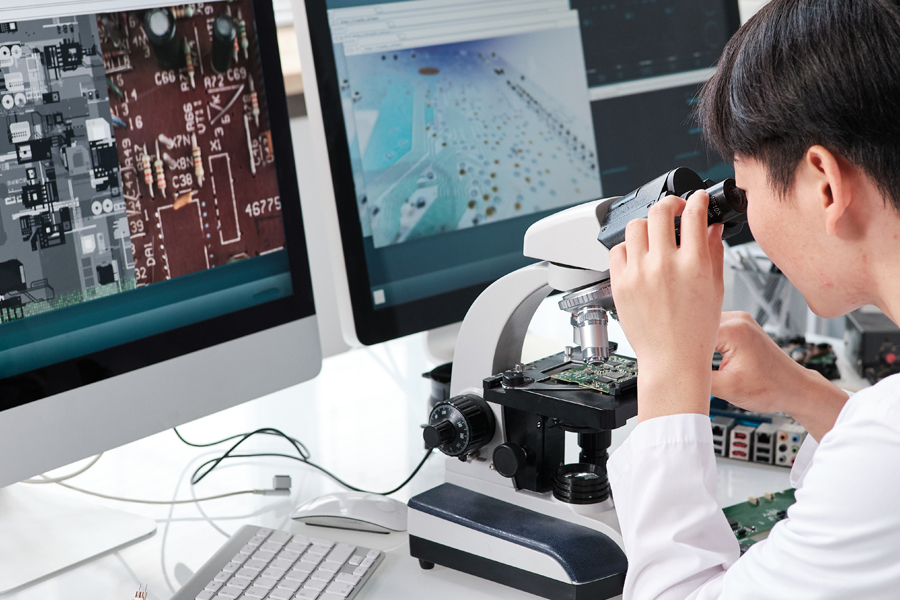
Illustration showing manual inspection of a printed circuit board (PCB) during electronics manufacturing quality control
Large-Scale Synthetic Dataset Generation
Using the syntheticAIdata platform, we generate extensive inspection datasets covering:
Missing or misaligned components
Placement deviations
Soldering defects
Surface anomalies and contamination
Lighting, camera, and angle variations
Every image is delivered with precise ground-truth annotations, ready fortraining detection, segmentation, and classification models.
Domain Randomization for Robust AI Models
A key advantage of synthetic data is control.
We systematically vary conditions that are difficult or costly to capture in real production:
Illumination direction and intensity
Camera resolution and positioning
Component color and reflectivity
Assembly tolerances and edge cases
This exposure enables AI models to generalize better and reduces sensitivity to small changes in production setups.
Validation on Real Production Data
Synthetic data only delivers value if it transfers to reality. DTI leads the evaluation phase, benchmarking AI models trained on synthetic data against real inspection data from Styromatic’s production environment. Performance metrics include:
Detection accuracy
False-positive and false-negative rates
Robustness to unseen defects
Training efficiency versus real-data-only approaches
The goal is not theoretical performance, but production readiness.
Why This Project Matters for Industrial AI
Faster Time-to-Value: Synthetic data allows AI development to begin before defects occur and before production lines are fully operational. This significantly reduces deployment timelines.
Lower Cost and Risk: By reducing reliance on manual labelling and defect collection, manufacturers lower both development cost and operational risk.
Scalable AI Across Product Variants: As products evolve, synthetic data pipelines can be updated faster than real data collection, supporting continuous AI adaptation.
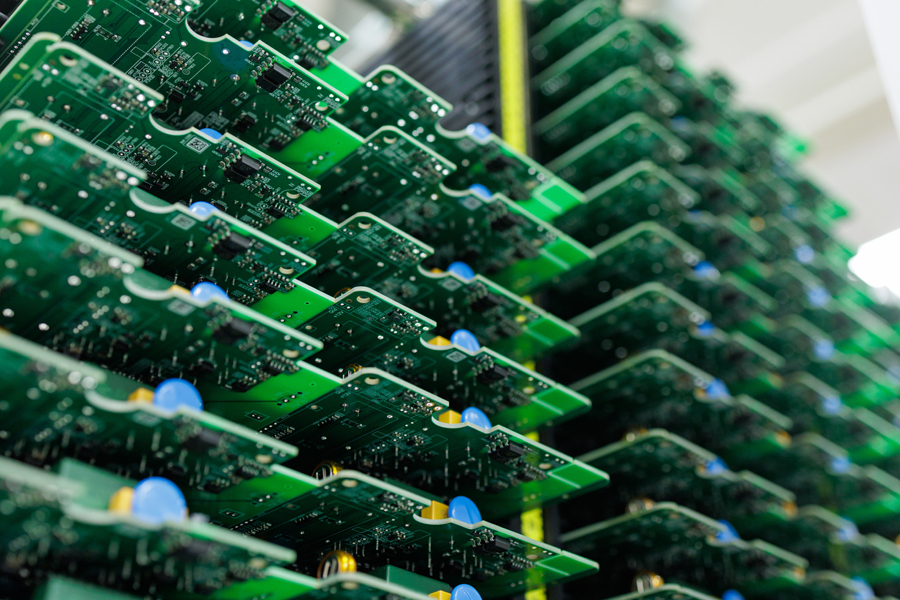
Illustration of mass-produced electronic boards highlighting the need for automated, AI-based quality control
Supported by Innovation Fund Denmark: A Signal of Strategic Importance
Support from Innovation Fund Denmark via the Innobooster program highlights the strategic relevance of this project for Danish industry.
The initiative aligns with national priorities around:
Digital transformation of manufacturing
Strengthening industrial competitiveness
Commercializing deep-tech innovation
Synthetic data is increasingly recognized as a foundational enabler for industrial AI at scale.
A Blueprint for the Future of Industrial Inspection
Electronics manufacturing is only the beginning.
The methods validated in this project are applicable across industries where inspection data is scarce, expensive, or sensitive. These industries include automotive, medical devices, and advanced manufacturing.
Our ambition is to help industrial teams move from AI experimentation to AI in production, faster and with confidence.
Looking Ahead
The project is now in active development. Over the coming months, we will:
Refine synthetic dataset pipelines
Train and benchmark AI inspection models
Validate performance in real production conditions
Share insights and best practices with the industrial AI community
We believe this collaboration marks an important step toward making synthetic data a standard tool in industrial AI workflows.
If you are exploring AI-based inspection or struggling with data availability, we invite you to connect with us.